Returning to Jamaica

I came home to Jamaica. Now I am learning how to live here again.

I left Jamaica at 14 and recently returned after decades living overseas. Living here now as an adult is a whole different experience that requires a different level of patience, which I do not always have. It is not the same as coming home for a holiday. The systems, the prices, the people, the potholes can work your very last nerve. Still, instead of running back to farin at the first sight of discomfort, I am choosing to learn how to make Jamaica my home again.

Marsha Kerr Talley
This is my experience For official requirements, still check with the relevant Jamaican authority.
This is what coming home really looks like

I love being home. That does not mean I am going to pretend everything works well.

There is so much I love about being back in Jamaica. There are also things that frustrate me, things that make absolutely no sense to me, and things I am having to relearn after decades away.

Some days Jamaica works my last nerve. Other days, somebody shows up with exactly the information, connection or kindness I needed. Both are part of coming home.

It is not about learning to beat the system. It is about understanding how things actually work.
What coming home has felt like for me

I have had some hard lessons since returning to Jamaica, and you will read about some of them here. But that is not the whole story. I have also had a tremendous amount of help.

I have literally made more contacts here in Jamaica in weeks than I did in the UK in three years. People have not gate-kept important information from me. They have put me on, told me who to call, where to go, what to ask, and sometimes helped me get into rooms I would not have known how to enter on my own. My experience so far is that when people realise you are ambitious, driven and serious about what you are trying to build, some people genuinely want to help you move forward.

My aunt told me I would regret moving back to Jamaica, and yes, there are moments when I ask myself, “Marsha, did you make the right choice?” So far, though, what I am realising is that I can make it here. I just need to learn HOW to make it here.

Living in Jamaica is not the same as living in the US or the UK, and that is okay. I do not need Jamaica to operate like somewhere else. I need to learn how to live here.

Audio series

Returning to Jamaica. The part that doesn't fit neatly into a guide.

This audio series chronicles my experience moving back in real time. Some situations are frustrating. Others are funny. There are those that make me question why on earth I decided to move back! Then, there are those moments that remind me exactly why I came home.

Latest episode This Week Was a Doozie! | Episode 1 Listen Close
Episode 01 12 September 2026 · 49 min

This Week Was a Doozie!

Two months into living in Jamaica again, I am still learning what it means to actually live here as an adult. This week brought the car, Jamaican roads and tolls, insurance and licence plates, job decisions, missing belongings, unexpected kindness, a beautiful date day and one very necessary reminder to slow down.

What happened this week?

I finally got my car, discovered just how serious a St Ann-to-Kingston commute can be, made some decisions about work and relocation, navigated another round of Jamaican paperwork, and found myself thinking about why I came home in the first place.

Somewhere in all of that, I realised something else too: trouble is not following me. People have shown up for me again and again. I am learning the systems, learning the pace and learning to give myself a little grace while I settle.

New recordings on Saturdays.

Saturdays with Marsha
01 Before you move

Handle what you can before you get on the plane.

Get the boring paperwork moving early. A TRN, Returning Resident approval, access to Jamaican dollars and one organised document file can save you a lot of running around later.

Scenic coastal road representing the journey home
Start here

Confirm Returning Resident eligibility

Do not assume you qualify just because you are coming home. Check the criteria and get the approval process moving.

Identity

Get your TRN early

Your TRN comes up repeatedly in tax, vehicle, banking and other Jamaican processes.

Money

Build a JMD landing fund

Have Jamaican dollars ready for deposits, transport, everyday transactions and the inevitable thing you did not budget for.

What documents should I gather before leaving?
Keep passport copies, proof of overseas residence, tax/employment records, proof of Jamaican address, Returning Resident correspondence, shipping records, vehicle documents, invoices and permits in one digital folder and one physical folder. Save copies offline too.
What should be on my household inventory?
Create a detailed list of shipped items, quantities and reasonable values. Separate used household effects from new items. Keep receipts for recently purchased items when possible and photograph valuable belongings before the container is sealed.
Will everyday processes feel different from the UK or US?
Yes, and some of them may work your last nerve. I recently had to print a physical copy of an invoice, physically sign it, and physically take it to a local business in order to get paid. In my mind, the exact same invoice submitted electronically should be just as valid for an audit. To me, that process felt redundant.

I am learning, though, that constantly comparing every Jamaican process with how I did things in the UK or US will frustrate me. Ask what the process is, prepare for it, and where you can respectfully suggest a more efficient way, do that. Sometimes the quickest route is simply learning how things currently work here.

What else should I budget for besides shipping?
Broker fees, port/storage charges, transport, housing deposits, utilities, temporary transport, insurance, food and setup costs can overlap. Keep a contingency reserve rather than planning down to the last dollar.
Citizenship paperwork can become part of the move too

My daughter’s Jamaican citizenship took about a year.

I started my daughter's citizenship process while we were still living in the UK and followed up religiously. A couple of months before we moved to Jamaica, I found out that her name had been misspelled in the process. I then had to spend more money getting photographs done again and paying to resend documents to the Jamaican High Commission in London.

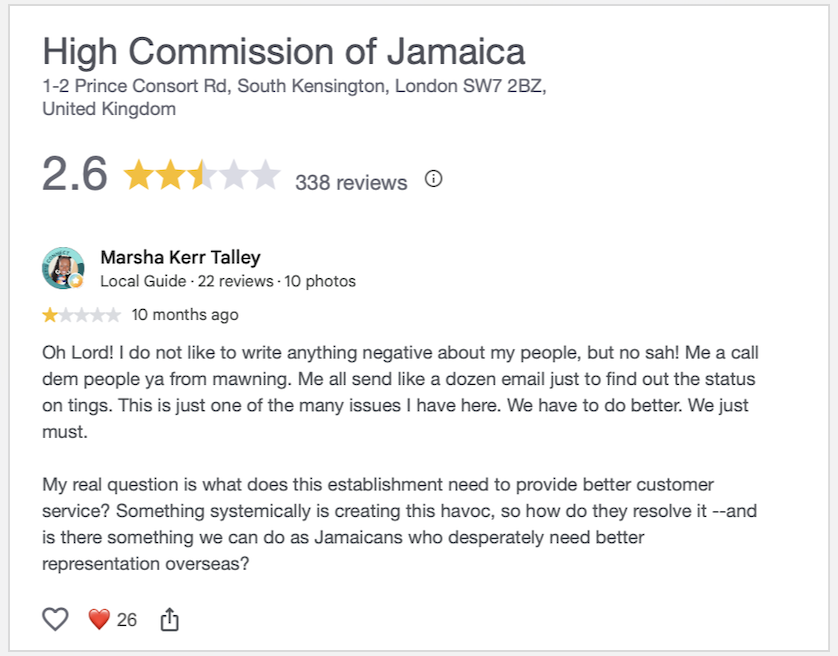
The frustration with the Jamaican High Commission in London had actually started much earlier. Before I even moved to Jamaica, only a couple of months after I first submitted my daughter's citizenship application and renewed my passport, I had already posted a Google review about the difficulty I was having getting updates and answers.

Google review I posted about the High Commission of Jamaica in London before moving to Jamaica
My Google review of the High Commission of Jamaica in London, posted before I moved to Jamaica. I was already documenting the communication problems only a couple of months after starting my daughter's citizenship application and renewing my passport.
Why this review still matters to me

Looking back at this review, I wonder if it is the reason my daughter's application was delayed and later sent back to the UK, despite them having plenty of time to ensure we could pick it up locally. Did my criticism have anything to do with what happened later? I do not know, but it would not be the first time it did.

Regardless of the answer, this is quite possibly why others may not say anything. When you operate within a links culture, it is hard to complain about the person, company or government office from where you still need help. People may decide not to write the email, make the report, escalate the complaint or even get the law involved because they are afraid speaking up could make things worse for them.

That fear cannot become the reason we stay quiet. There should be systems strong enough that somebody can question a charge, challenge poor service, file a complaint or ask for accountability without wondering whether doing so will affect how they are treated afterwards. Accountability is necessary.

One thing that helped was keeping the same email thread going. I spoke with different people and emailed managers, but keeping the history together made it much easier to show what had already been said, what I had sent and what I was waiting for.

When we arrived in Jamaica in July, we went to PICA in person to check the progress. We were told to write a letter asking for the citizenship certificate to be collected locally when it was ready. Later, someone called and told me we had to come back to PICA and write a second letter because the first one had been written on the wrong paper. We got a ride there and did it again.

Yet when I followed up in August, I was told the certificate had been mailed back to the UK because our request to collect it in Jamaica had not been received in time. That was after I had sent several emails saying that we were now living in Jamaica, asked whether the requested letter could be sent electronically, sent one electronically anyway, and physically went to PICA twice.

I initially asked for a digital copy and was told that could not be done. After I asked both PICA and the Jamaican High Commission in London for the information I needed to make a formal complaint, someone sent me an electronic copy of my daughter's citizenship certificate and said the physical document would be sent back to the local office. I am still following up for the formal complaint information because this is exactly why keeping a paper trail matters.

For context: PICA currently says compliant Citizenship by Descent applications are processed within 90 working days under regular service. PICA also currently offers a 45-working-day expedited service for local applicants and London applicants. My experience took far longer than that.

At one point I was so frustrated I wondered whether I had pissed somebody off. I have no evidence that was why the document was sent back overseas. I simply could not understand why it happened after all the emails and the two visits to PICA.

Illustration of a Customs broker assisting a returning resident at a cargo wharf
02 Shipping your belongings

Before your things leave farin, know exactly who is handling them in Jamaica.

The company you pay overseas is only one part of the story. Find out who will actually touch your shipment once it reaches Jamaica.

Consolidate

Ask about one container

If sending a car and household goods, compare the full cost of shipping them together versus separately.

Verify

Know your Jamaican broker

Before you pay, get the name, number and actual role of the person handling clearance in Jamaica. 'Somebody will deal with it' is not enough.

In writing

Get the full cost breakdown

Ask what your money covers, what it does not cover, when storage starts and who is responsible at each stage. Get it in writing.

The day I had enough

I finally got my car. The process of getting it was another story.

I recorded this sitting in my car after dealing with all sorts of nonsense regarding my car and personal belongings. I was tired, sweaty and completely irritated at this point. The day before was a whole other ordeal, but I will save that story for another day.

Initially, I posted the video to Facebook, but quickly decided to delete it. I wanted to share it here with context. Instead of only sharing my frustration, I wanted to share what I learned from the process and give you practical ways to avoid some of what happened to me.

What happened and why I am sharing it
Marks and scrapes around the charging-port area of my Nissan Leaf after collection
Dark scrape on the white side body panel of my Nissan Leaf after collection
Scratches and marks on the rear bumper of my Nissan Leaf after collection
Scrape near the rear wheel arch of my Nissan Leaf after collection
Exterior roof area of my Nissan Leaf photographed after collection
Open interior trim compartment visible inside my Nissan Leaf after collection
Dirty driver footwell and loose trim piece inside my Nissan Leaf after collection
1 / 7

These are some of the photos I took after receiving the car.

I hate posting anything negative online about my people or country, but the way many in Jamaica run businesses have got to change.

Imagine you spend yuh big big money fi ship yuh tings dem from farin. Only to end up in hell and powda house fi get them. It does not need to be this way, but the lack of accountability here is a problem.

We need systems in place that can hold Customs, wharf employees, brokers and the other people we depend on in this process accountable. Jamaica wants to become a developed nation, and this is one of the places where we can lead the way.

My experience is not the only story I have heard. People have shared their own shipping and vehicle-damage experiences with me. One man told me about a vehicle where part of the top was cut so it could fit in a container. Another told me about a car being badly scratched by the straps used to secure it. Those are accounts people told me directly, not incidents I independently verified, but they are another reason I now tell people to photograph and video the vehicle carefully before it is loaded and again before accepting it after shipping.

The bigger issue for me is accountability. Jamaica runs heavily on “links.” Somebody knows somebody, somebody can give you a number, somebody can make a call. I have benefited from that generosity since coming home, and I am grateful for it. But links alone cannot be the entire system. When friends know friends, it can also become difficult to challenge poor service. A returning resident who knows nobody should still be able to understand the process, see what they are paying for, know who is responsible and have somewhere meaningful to go when something goes wrong.

My advice now: get names, fees and responsibilities in writing; keep every receipt and payment record; ask for the official document behind any charge you do not understand; and move important conversations out of phone calls and into writing. A “link” can help you find the right person. It should never replace a transparent process.

If something goes wrong, create a paper trail and escalate it.

Start with the company that actually handled the part of the process you are challenging. The shipping line, freight forwarder, terminal operator, broker and Jamaica Customs do not all perform the same role, so send the complaint to the organisation that was responsible for the disputed service. Ask for a written response, a claim or reference number, the company's claims procedure and any applicable insurance information. Attach the bill of lading, invoices, receipts, before-and-after photographs, collection documents, dates, names and repair estimates where relevant.

Shipping company, freight forwarder or terminal

Make the written claim directly first. Check the bill of lading or contract for notice deadlines and claim requirements. If you are unsure which local company handled the cargo, the Shipping Association of Jamaica directory can help identify shipping agents, freight forwarders and terminal operators.

Licensed Customs Broker

Complain to the broker in writing first. Jamaica Customs licenses Customs Brokers. If the problem concerns a broker's customs work or conduct and is not resolved, contact Jamaica Customs Customer Service and provide the broker's name and your supporting documents.

Jamaica Customs Agency

For a Customs service complaint, use the JCA General Queries or Complaints Form, email public.relations@jca.gov.jm, or call Customer Service at 876-948-7849 or toll-free 1-888-287-8667. JCA also lists quick.response@jca.gov.jm for general contact.

Consumer Affairs Commission

If you paid a Jamaican business for a product or service and the complaint remains unresolved, the CAC accepts formal consumer complaints. Its current contacts include complaints@cac.gov.jm, info@cac.gov.jm, 876-906-5425 and 876-619-4222.

PICA or citizenship service problem

Keep one email thread and ask for a case or ticket number. PICA currently lists 876-754-PICA (7422) and support@picahelpeu.freshdesk.com. Its REL-M customer relationship system is also designed to track issues. Citizenship services are handled at 8 Waterloo Road in Kingston and through Jamaican overseas missions.

If the problem crosses an overseas Mission and Jamaica

For a citizenship matter involving an overseas Jamaican Mission, copy the Mission and PICA so both sides can see the same chronology. The Jamaican High Commission in London is currently listed at jamhigh@jhcuk.com and +44 20 7823 9911. The Ministry of Foreign Affairs and Foreign Trade also lists consular@mfaft.gov.jm for Consular Affairs.

What should I check on the bill of lading?
Confirm your name, consignee details, destination, container information and vehicle details. Keep the final bill of lading accessible.
How quickly should I collect my shipment?
Arrival does not mean immediate release. In my experience, allowing roughly one to two weeks for clearance is sensible, although actual timing varies. Once you receive the release or collection message, move quickly to reduce avoidable storage charges.
What about pets, plants and restricted items?
Check permits before packing. Pets and plants can require prior approvals. Never assume something can simply travel inside the container.
03 Importing your car

Do not put your car on the water and then start figuring out the paperwork.

Car-import mistakes can get expensive very quickly. Know the ownership requirement, get the permit sorted before shipping, and do not assume Returning Resident status means the vehicle is duty-free. Under the current Returning Resident rules, an eligible returnee may import a motor vehicle up to 10 years old, with full duty and taxes payable.

Important: under the current Returning Resident motor-vehicle rules, the vehicle must have been in your possession for at least six months. Returning Resident status does not make the vehicle duty-free.
Cargo ship loaded with containers at port
Permit

Apply before shipping

Complete the Trade Board vehicle import permit process before making final shipping arrangements.

Documents

Keep proof of ownership

Have the title/export record, seller invoice and evidence showing when you bought the vehicle.

Clearance

Prepare your TCC + broker

A TCC (Tax Compliance Certificate) is required for motor-vehicle clearance. The vehicle must also be cleared through a licensed Customs Broker.

What about the seller invoice?
Ask the dealer or seller for a properly completed invoice or bill of sale at the time of purchase. It is much easier than trying to reconstruct the paperwork months later.
Does a used UK vehicle need inspection?
Imported motor vehicles require a pre-inspection certificate from the country of export before importation. If you are shipping from the UK, confirm the current approved inspection process before the vehicle leaves.
Should I let someone import the vehicle in their name?
Do not use an informal arrangement simply to avoid paperwork. The importer named in the documents carries legal and financial significance. If someone proposes a structure you do not understand, get it explained in writing first.
Tropical fruit and produce at a local market
04 Arrival + money

Once you land, start asking people what things are supposed to cost.

Learn what things normally cost. Use Jamaican dollars where it makes sense, keep payment records and ask people who actually live here where they shop.

People have been one of the best parts of coming home. Somebody knows somebody. Somebody gives you a number. Somebody tells you where to go, what to ask or who to speak to. I have benefited from that generosity more times than I can count. I just do not want to confuse having a link with having a transparent system.
Currency

Learn when JMD makes more sense

Repeated card conversion and foreign-currency pricing can quietly eat into your money through rates and fees.

Protection

Use traceable payments

For major purchases, favour methods that leave a clear record and may offer dispute protection.

Local life

Ask where people really shop

Farmers, market days and local suppliers can be very different from prices in tourist-heavy areas.

What should I know about cash and transfers?
Keep useful cash, but not all of your money in cash. Avoid irreversible transfers to people you do not know simply because you are being pressured to act quickly. Use your common sense even when someone makes a situation feel urgent.
What about transport while I wait for my car?
If route taxis are limited where you live, a short-term rental can be more practical and sometimes more economical than repeated private taxis or ride-hailing. Uber and other app-based options are available in parts of Jamaica, but availability can change by exact location. If you are going somewhere remote, think about the return trip before you leave and keep the number of a reliable local driver. See the Getting Around + Useful Apps section for the fuller transport and safety notes.
Where should I buy food?
Ask when farmers bring produce directly to your local market. PriceSmart can be useful for bulk purchases, but compare unit prices. Tourist-heavy areas such as Ocho Rios, Montego Bay and Kingston can feel especially expensive.
People + connections

Network. Meet people. Just be intentional about it.

Since moving back, I have been connected to a LOT of people. Some of those introductions have helped me solve problems, find opportunities and get into rooms I would not have known about otherwise. Jamaica can be very relationship-driven, and WhatsApp groups are everywhere.

That can be a beautiful thing. It can also become noise very quickly.

Every contact does not need to become a friendship. Every event does not need your attendance. Every WhatsApp group does not need your daily attention.

01

Go where your interests are

Attend events that connect to the life, work or community you are actually trying to build. You do not have to be everywhere.

02

Use WhatsApp groups on purpose

They are useful for information, referrals, events and introductions. Mute the noisy ones. Leave the ones that add nothing. Protect your attention.

03

Follow up with the right people

If you have a good conversation, send the message. Save the number with a note so six weeks later you remember who the person is and where you met.

04

Do not confuse access with trust

Someone giving you a “link” does not automatically make that person, or the person they referred, trustworthy. Verify what needs verifying.

05

Let relationships be reciprocal

Networking should not feel like collecting people for what they can do for you. Share information. Make introductions when appropriate. Be useful too.

06

Keep some boundaries

You can be warm, open and connected without telling everybody everything. Be selective about who gets access to your plans, finances and personal life.

What I am learning: relationships matter here, but intentional relationships matter more. Build your circle. Show up. Talk to people. Take the number. Join the group. Then use your judgement. You do not need 500 contacts. You need good people you can actually call, and people who know they can call you too.

05 Getting around + useful local apps

You can manage without a car, but plan the ride back before you go.

This was one of those things I learned very quickly. You can get taxis and, in some areas, use ride-hailing apps. I have even been able to get an Uber up into more remote places. The problem is not always getting there. Sometimes the bigger question is: how are you getting back?

What I would do

If a driver takes you somewhere that is harder to reach, ask whether they are available to collect you later. Save the number of a reliable local taxi driver. If you decide to arrange a return trip directly with a ride-hailing driver, remember that a trip arranged outside the app may not have the same in-app tracking or protections.

Local people can also be a huge help here. A driver who cannot collect you may know another driver who can. That has been part of my experience of Jamaica too. People will often give you the link rather than leave you to figure everything out alone.

Before you get into an Uber or other app-booked car, CHECK.

Do not get into a vehicle simply because someone says they are your driver. Match what is in the app first.

1. Match the licence plate Check the plate against the one shown in the app. If it does not match, do not get in.
2. Check the driver + vehicle Compare the driver's photo and the vehicle make/model with what the app shows.
3. Use the PIN + share your trip If your app offers ride PIN verification, use it and wait for the trip to verify before you leave. Share your live trip/location with someone you trust.

Uber's Jamaica safety guidance specifically tells riders to match the plate, vehicle and driver before entering, and its Verify Your Ride feature can require a four-digit PIN before the driver starts the trip.

I turned down the same driver twice because the licence plate did not match the app. The first time, the car arrived with a completely different plate from the one Uber showed me.

The first time she arrived, the car had a red plate with a completely different number from the one shown in the app. I questioned her about it. She told me she had upgraded her licence but had forgotten to update it in the app. Then she said, “It’s me. Don’t I look like the person on the app?”

When I was still reluctant, she told me that if I did not want to get in, I did not have to. Sure enough, I did not. I was with my daughter, and I did not think getting into a stranger’s car when the licence plate was completely different from the one attached to the service was a wise lesson to model for her.

The second time, I matched with the same driver again. This time I asked explicitly whether the licence plate was the one shown in the app. At first she said yes. She then messaged me the actual plate number through the app, and it still did not match. She said she had updated it but the change was not reflecting. I cancelled the ride and requested another Uber. The next driver arrived with a licence plate that matched the app. I got in.

For me, that is the line: if the identifying information in the app does not match the vehicle in front of me, I do not get in.

Ride options

Uber is not the only name to know

Uber currently lists service in Jamaican markets including Kingston and Ocho Rios, and its Montego Bay page also confirms availability there. Supply can still change by the exact pickup point.

Jamaica's Fair Trading Commission has also discussed inDrive, Ride Jamaica and 876 On The Go as ride-hailing model operators. The 876 On The Go app allows people to book rides now or later with a licensed taxi company, but the app itself warns that vehicles may not be available in every area. Check the app before depending on any service for a time-sensitive trip.

Local SIM

Get a Jamaican number early

A local number becomes useful almost immediately for brokers, shipping calls, deliveries, drivers, WhatsApp, banking verification and everyday life.

Flow supports eSIM on compatible devices. In my case, an eSIM is particularly useful because you can get local mobile service without depending on a removable physical SIM. Check Flow's current activation instructions for your device and plan.

Food + groceries

Delivery exists outside Kingston

Do not assume every errand requires a drive. 7Krave offers restaurant delivery and also has 7Kravemart for groceries. Its current delivery policy lists Kingston & St Andrew, Portmore, Ocho Rios and Montego Bay, with charges varying by area.

Coverage changes, so enter your actual address in the app rather than assuming a service reaches your community.

Electric vehicles

If you bring an EV, set up charging before you need it

  • Download both apps early: Evergo and ChargeLab for JPS Charge 'N Go.
  • Create your accounts on reliable Wi-Fi: add your payment details and make sure you can log in before setting off.
  • Get the RFID cards too: weak Wi-Fi or mobile data can make it difficult to start a charge through an app. Keep the cards in the car as your backup.
  • JPS Charge 'N Go card: create your ChargeLab account, then request/register an RFID card through the ChargeLab/JPS process. JPS also provides EV support for card pickup or delivery.
  • Evergo card: create your Evergo account and use the app to buy, link and manage an RFID card.
  • Fund the account before travelling: do not wait until your battery is low to discover that your wallet, card or app still needs setup.
  • Test both networks while you still have range: learn how the charger, app and RFID card work before you are depending on them.
  • When using Evergo: disconnect and move the car when charging is finished so you do not risk additional occupancy charges.
My tip: The app is convenient when your signal is good. The RFID card is what I want in the car when it is not.
Buy + sell used

There are local alternatives to Marketplace-style browsing

Amber Eazzy is a Jamaican marketplace for buying, selling, renting and finding items and services. Listings can include cars, furniture, property, electronics and more, and the app supports filtering by parish.

Use the same caution you would on any marketplace: verify what you are buying, meet safely, keep payment records and do not let urgency push you into an irreversible payment.

A simple habit

Save good numbers

When you find a reliable taxi driver, tradesperson, broker, delivery person or service contact, save the number. Jamaica becomes much easier when you begin building your own trusted little network of people you can actually call.

That is one of the biggest differences I have experienced since coming home: people have given me contacts instead of gate-keeping them.

06 Power + connectivity

Electricity and internet can humble you quickly. Have a backup.

If your income depends on being online, one internet connection and one source of power may not be enough. I learned that one early.

Solar panels on a tropical-style home
Sun

Use solar where it makes sense

Homeowners can price rooftop systems. Renters can use portable solar panels and power stations for essentials.

Internet

Have a Plan B for internet

If you work online, keep mobile data or another backup available even when you have fixed broadband or Starlink.

Storm season

Do not wait for the outage

Battery storage, charged power banks and a properly used generator can make outages much easier to manage.

“The modem was already in the house. That did not mean I had working internet.”

My internet experience

Flow was recommended to me and there was already a modem in the house, but I still could not get a working connection. Even after bills were paid, unresolved issues prevented service and I was told a technician was not being sent for new accounts at that time.

Digicel customer service was better in my experience, but service was inconsistent. After one outage I was still waiting weeks later for a technician call-back, so I moved to Starlink. Starlink has been more dependable overall, though I still find it slow at times. I especially appreciate being able to reach support directly through the app.

What happened with the unexpected “Digicel technicians”?
A man called saying he was coming to check my Digicel internet and gave me his name and a colleague’s name. Because I live in a gated community, I gave those names to security so the men could be admitted. When they arrived, neither their clothing nor their vehicle displayed Digicel branding.

Afterwards, I called Digicel to discuss the visit and was told there was no record of Digicel sending anyone out and no work order showing that technicians had been assigned to my home. Understandably, that frightened me. Security confirmed that the men had checked out of the community.

I then called the person who had originally contacted me. He explained that they did not work directly for Digicel, but were subcontractors working through Konnex, and that jobs could be shared through a WhatsApp group for technicians in the area to pick up. I could not independently reconcile that explanation with what Digicel customer service had told me.

My takeaway: even when a caller knows details about your service problem, verify the visit. Ask the provider for the technician’s name, contractor company and work-order/reference number. If you live in a gated community, give security only verified names. If anything does not match, do not feel pressured to let someone into your home while you are trying to sort it out.
How can I keep electricity costs under control?
AC can become expensive if it runs all day. Use blackout or thermal curtains, fans where comfortable, and keep windows closed during peak heat if the outdoor air is hotter than the inside. Open windows early morning, evenings or after rain when the outside temperature is actually cooler.
What should renters consider for solar?
Portable solar panels paired with a battery power station can keep routers, laptops, phones and lights running without permanently altering the property. Calculate what you actually need to power and for how long before buying.
Can rainwater help?
Covered rainwater storage can support gardening, cleaning and other non-potable uses. Keep tanks covered and maintained so they do not become mosquito-breeding sites. Water intended for drinking or food preparation must be handled and treated safely.
07 Renting, buying + choosing where to live

Choose the home that fits your life, not somebody else’s commission.

Know your real budget before somebody starts showing you houses. Know the kind of community you actually want too. A pretty house is not enough if the location, cost or lifestyle does not fit your life.

A good local agent should help you work within your budget and priorities. Give them your comfortable range and your absolute ceiling before they start sending properties.
Gated community Modern amenities + controlled access Newer homes, pools, gyms and maintained common areas can be appealing, but still check security, fees, rules and how much freedom you really have.
Established community Mature trees + individuality + local character If you want mature trees and that real Jamaican feel, a gated resort-style community with cookie-cutter houses and an association telling you what colour you can paint your house may not be it.
Your budget

Make the budget a boundary

Tell the agent what you can comfortably afford, not simply the largest number a lender says you qualify for. If most of the properties being shown are above your range, redirect the search.

Buying

Get mortgage pre-approval first

If you plan to finance the purchase, obtain a current mortgage pre-approval, or refresh an older one, before seriously viewing properties. That gives you a clearer ceiling and can make the process smoother when you find a house you want.

Agent fit

Work with someone who listens

Commission is part of real-estate transactions, so your interests and the agent’s incentives are not automatically identical. You want an agent who respects your limits instead of continually steering you toward a more expensive sale.

“Gated” does not automatically mean safe. “Ungated” does not automatically mean unsafe.

Do not buy the stigma. Look at the actual community.

There can be a stigma around older or ungated Jamaican communities: that they are dirty, run-down or unsafe. That is too simplistic. Some established communities have mature trees, larger lots, individuality, long-term neighbours and the Jamaican residential feel that some returnees are actually looking for.

Gated developments can offer newer homes, pools, gyms, landscaping, controlled entry and other conveniences. They can also experience security incidents, and the lifestyle can come with association fees and rules governing things such as exterior changes, parking, landscaping or even what colours a house may be painted.

Should I rent first or buy right away?
Renting first can give you time to learn traffic patterns, utility reliability, internet options, noise, shopping, flooding/drainage, commute times and the personality of different communities before making a long-term commitment. Buying immediately may make sense if you already know the area well, have financing or cash organised and have done appropriate property due diligence. Neither route is automatically better.
What should I tell a real-estate agent before we start?
Give them your preferred area, realistic monthly rent or purchase range, absolute maximum, number of bedrooms, must-have features, deal-breakers and whether you want gated, established, rural, town-centre or resort-style living. Ask them not to send properties above your ceiling unless you specifically request comparisons.
What should I check before renting?
Test water pressure, internet availability, mobile signal, AC units, appliances, doors, windows and security features. Ask who pays utilities and maintenance, what is included in the rent, how deposits are handled, whether there are community fees or rules, and what happens when something breaks. Photograph the condition of the property when you move in.
What should I check before buying?
Beyond the appearance of the house, investigate title and legal ownership, boundaries/survey information, property taxes, community or maintenance fees, access roads, drainage/flooding, water storage, electricity, internet, structural condition, insurance considerations and any restrictions that affect how you can use or alter the property. Use qualified Jamaican legal and property professionals for the formal checks.
How should I compare gated and ungated communities?
Visit at different times of day. Talk to people who actually live there. Look at lighting, pedestrian activity, road condition, drainage, access to shops and transport, noise, trees and shade, lot size, privacy, community rules and actual security practices. If you are looking for mature trees and that real Jamaican feel, a gated, resort-style community with cookie-cutter houses and an association telling you what colour you can paint your house may not be it. On the other hand, if controlled entry, newer amenities and a more uniform community are what make you comfortable, that may be exactly what you want.
Accent, belonging + coming home
“I know when to speak patois. I am not going to perform it to gain respect around here!”
🎧 A real conversation from my return

Coming home should not require proving that you are Jamaican.

One of the more unexpected parts of returning has been thinking about when I speak patois, when I use Standard English, and how people sometimes respond to the accent I brought home with me.

In this private conversation, I was talking to a local driver who advised me to chat patois to get better prices and treatment in certain situations. I understand what he means, but I speak patois when it comes naturally to me, not when I am forced. I should not have to switch up how I speak in order to receive fair treatment, a fair price or basic respect. I know that is typical overseas, and I am aware of code switching, but I am not going to do it by coercion in the place of my birth.

My perspective: Jamaicans who remained on the island are not unfamiliar with Jamaicans living a farin, so returning home with a different accent or a little twang is no surprise to anybody. Our little accents do not make us less Jamaican. A returning resident should not have to cuss someone out, exaggerate patois, or prove themselves to be treated properly.
Why this matters for returning residents
Yes, people read your accent before they find out about you. They assume all sorts just because you sound like a tourist. While code-switching may be natural communication for many, including me, it can feel like pressure to perform familiarity so that you are not overcharged, dismissed or treated as an outsider. As a returnee, it is important to learn from the locals. Ask what things normally cost and build relationships with them. Of course, be selective like you would anywhere else, but do not feel that you have to put on a front to be accepted.
Marsha Kerr Talley speaking
08 Actually living here

At some point, you have to stop relocating and start living.

Clearing the container is one thing. Building an actual life is another. Your people, your routines, healthcare, transport, security and knowing who to call all matter.

🤝

Give yourself time to learn Jamaica again. Returning home does not mean you automatically know how everything works here now. You may know the culture, the food, the language and the people, yet still have to relearn systems, prices, places and everyday ways of doing things. That does not mean you made the wrong decision. It means you are settling in.

Community

Build your circle carefully

WhatsApp groups can connect you to jobs, events, services and people quickly. Join them, but do not let every group have unlimited access to your time.

Security

Create the home setup you need

Exterior lighting, cameras, secure locks and knowing your neighbours can help you feel settled without living in fear.

Mindset

Do not spend the whole move being afraid

Meet people. Go places. Learn your community. Do not let fear turn coming home into sitting behind a gate watching Jamaica from the window.

Medication + chronic conditions

If you rely on regular medication, sort this early.

  1. Bring enough medication for the transition. Do not wait until you are almost out.
  2. Bring your medical records. Keep your medication list, dosages, diagnosis information and recent relevant test results.
  3. Find a Jamaican doctor. Take your records and current medication so the doctor can review your condition and issue local prescriptions where appropriate.
  4. Get your TRN. You will need it for an NHFCard application.
  5. Apply for an NHFCard if your condition qualifies. A registered doctor must certify the condition.
  6. Check whether your medication is subsidised. Use the NHF benefits search because not every drug is covered.
  7. Take your prescription and NHFCard to a participating pharmacy. You pay the remaining balance after the approved subsidy.
  8. Use Drug Serv if it fits your care. Public patients can access NHF Drug Serv pharmacy locations at hospitals and selected health centres.
  9. Ask about availability before you run out. Your exact medication may not always be stocked, so discuss appropriate alternatives with your doctor or pharmacist.
What should I know about public healthcare?
Jamaica maintains a no-user-fee policy for qualifying public patients in public facilities. That does not mean every medicine, test or private service is automatically free. Many people still keep private insurance or an emergency medical fund.
Should I apply for NIS?
NIS is Jamaica’s compulsory contributory social-security programme for people in insurable employment. Generally, people ages 18 to 70 who are gainfully occupied, including employed and self-employed persons, are required to be registered. Check your category and complete registration early.
What about a Jamaican driving licence?
Do not assume one rule fits every returning resident. Requirements can depend on your existing licence and the transaction you are completing. Confirm current requirements with the Island Traffic Authority and Tax Administration Jamaica. For a first learner's permit, the current process includes the Road Code Test and supporting documents such as certified passport photographs, proof of residence/identity, a medical certificate, TRN and proof of age.
What should I prepare for hurricane season?
Keep water, flashlights, charged battery banks, basic medicines, important phone numbers and a modest cash reserve. If your work depends on internet, test your backup data and power arrangements before a storm is approaching.
A conversation worth having

Coming home also means asking what kind of Jamaica we are building.

Returning to Jamaica has made me think much more seriously about what it actually takes to make returning home sustainable, not only emotionally, but financially and practically. A recent Facebook conversation captured many of the questions I keep coming back to.

My response

I just move back, and can second that Jamaica cannot stand still.

I love Jamaica enough to want better for it. Returning home has made the gaps between our ambition as a country and some of our everyday systems impossible for me to ignore.

Read my full response

If the vision is to make this country a developed nation, we cannot stand still.

First, we need to address cost of living, how much professionals with degrees get paid, and the cost of housing here. Foreign investors should not have the ability to buy up so much of Jamaica and sell back to Jamaicans at outlandish prices!

Jamaicans are priced out of housing here and the roads to anywhere that have generational land/houses are in abysmal conditions. These potholes should have a felony. It is a crime what they do to people’s cars and confidence here!

Additionally, with all the technology that is available on the island, why are we still asking for paper invoices with a wet signature and to hand deliver it?! Why are you asking people to stand in lines for decades? Why are some businesses still allowed to be chakka chakka in how they do things?

Jamaicans from the diaspora are returning home, but far too many are not staying. What are the incentives to keep returning residents here? If we are not making life attractive for Jamaicans and our children, outside of tourism, who will inherit this island: the investors buying it up?

We need teachers and doctors, yet has ANYBODY seen how much these professionals get paid or the conditions under which they are asked to work?

I’m a teacher with degrees and decades of experiences in multiple countries, but I better work an overseas online job if I want to afford living at home. If our skilled workers are teaching online or overseas, how does that help the economy on the island?

Yeah...Jamaica cannot stay still.

Why I am including this here: this page is not only about forms, shipping and logistics. Returning home also raises bigger questions about affordability, infrastructure, professional opportunity, public systems and whether Jamaica is creating the conditions for its people, including returning residents, to stay and build here.
Interactive planner

Things I would sort before landing.

Use this as a running list. Tick things off as you sort them; your progress stays saved in this browser.

0% ready
60-second check

How ready are you, really?

Seven quick questions. No email. No sales funnel. Just check where you are.

1. Have you confirmed Returning Resident eligibility?

2. Do you have your TRN and Jamaican money plan?

3. Do you know who will handle your shipment in Jamaica?

4. If importing a car, is the permit process ready?

5. Do you have extra funds for the first 4–8 weeks?

6. Do you have trustworthy local contacts?

7. If you rely on internet/power for work, do you have a backup?

The question underneath all the checklists
“Can I actually make a life in Jamaica?”
My answer so far

Some days I ask myself, “Marsha, did you make the right choice?” I still believe I did.

If you are thinking about coming home, I know you are not only looking for Customs forms and phone numbers. You are trying to picture an ordinary Tuesday here. You are wondering whether you can actually build a life.

You want to know what happens when the excitement of moving wears off. Will you find your people? Can you get things done? Will you feel safe? Can you afford to live? Will people help you? Will you regret it?

I cannot answer all of that for you because your experience will be your own. I can tell you that mine has been a mixture. Some processes have frustrated me. Some things have cost more than I expected. I have had moments of wondering what on earth I was doing.

I have also met people who have freely shared information, made introductions, helped me solve problems and encouraged what I am trying to build. That matters. I have been able to create connections here remarkably quickly.

This is where I am right now: I do not need Jamaica to be America or England. I came home because I wanted Jamaica. What I need is to learn how to make a good life here without accepting every frustrating process as “just how Jamaica is.” I can love my country and still believe we can do better. Both things can be true.
Follow the journey · Get help

Come home with the story, or bring me into yours.

If you are enjoying the Returning to Jamaica series, subscribe for new stories, audio episodes and updates.

If you are planning your own return and trying to make sense of the moving pieces, I can also sit with you, help you organise the questions and think through what needs to happen first.

Practical guidance from lived experience. I am not your lawyer, Customs broker, tax adviser or immigration representative.

Two people having a consultation over coffee with a Live Inspired journal on the table
Stay with the journey

Want the next Returning to Jamaica update?

Subscribe for new writing, audio and updates from me directly.

Candid Conversations with Marsha Jamaica, life and the conversations in between.

Join me on Substack for new writing, audio episodes and updates.

Subscribe on Substack
Official sources + practical references
Important: Jamaican government requirements, fees and processes can change. Always reconfirm official requirements before paying, shipping or submitting an application.

Government and service information on this page was rechecked against current public sources on 13 September 2026.