
Classroom Ecology: The Missing Conversation in Teacher Burnout
March 5, 2026 | Teacher Retention, Learning Environments
A reflection that explores how classroom environments influence behaviour, engagement, and teacher burnout.
by Marsha Kerr Talley
A lot of teachers are leaving education.
They are sick and tired of being sick and tired.
When conversations about student disruption happen, they usually focus on discipline policies or consequences. Those things matter, but they are only part of the picture.
We also need to talk about classroom ecology.
Over the past two decades, working in both the United States and the United Kingdom with learners ranging from young children to adults with special, learning, and emotional needs, I have learned something important:
Many behaviour challenges can be mitigated through the learning environment itself.
Classroom ecology includes things like:
- how the room is arranged
- how much movement is built into the lesson
- how engagement is structured
- how transitions are handled
- how sensory input affects attention and regulation
- how administrators support teachers in upholding discipline
Throughout my career, I have used classroom design, movement-based learning, structured engagement, and relational leadership to shape learning spaces that regulate rather than escalate.
Students participate more and disruption decreases when environments are intentionally structured. Misbehaviours do not disappear, but they become far less frequent.
When teachers spend less time managing behaviour, the real magic happens.
This is not theory for me. I have seen it work repeatedly across different education systems, age groups, and learning environments.
That said, there is another part of this conversation that leaders must address.
Teachers cannot build healthy classroom environments if they are left unsupported. When disruptive behaviour is minimised, ignored, or brushed aside, it sends a message to staff that they must carry the burden alone.
School leaders and decision-makers must support staff by:
- establishing clear and consistently applied behaviour systems
- ensuring staff know they will be backed when they enforce expectations
- providing practical training on engagement, movement, and classroom environment
- recognising that supply and substitute teachers often face the most difficult behaviour with the least support
- creating a culture where behaviour is addressed proactively rather than reactively
- remembering the quiet students and ensuring every learner feels welcome and safe
If we want to reduce teacher burnout and improve student outcomes, we must examine classroom ecology and the systems that support it.
Classroom culture is not accidental.
It is shaped by leadership, environment, and intentional practice.
What Classroom Ecology Looked Like in My Classroom
Over the years, my classrooms looked different from many traditional classrooms.
I kept the lights dim and used lamps that I often bought from thrift stores. The goal was to create a calmer environment that felt less institutional and more welcoming.
I had couches, mats, plants around the room, and even curtains by the classroom door to create a sense of comfort. Students often said my classroom felt more like a living room than a typical classroom.
Music was also part of the ecology.
During independent work time, I played quiet instrumental music—often classical music or gentle ocean-wave sounds. It helped students settle and focus.
At the beginning of class, I would play upbeat, current music. Students would often run into the classroom because they wanted to hear what was playing.
Music also helped with transitions. When the end-of-class music started, students knew it was time to wrap up.
I also used essential oils and diffusers. Lavender and peppermint were particularly effective, especially in classrooms with students who had sensory or emotional regulation needs.
Some people were skeptical at first, but the results spoke for themselves. Both teachers and students often commented that my classroom felt calm, welcoming, and focused.
Students wanted to be there.
That matters. When students want to be there, behaviour improves. Attendance was rarely an issue for me, even with adult learners.
Interestingly, I was able to replicate this same ecology in the online learning environments. The principles were the same: engagement structure, movement, clear expectations, and creating a safe space where learners felt comfortable participating.
Movement Matters
Movement was another essential part of my classroom design.
Students were rarely expected to sit still for long periods. Lessons included movement-based activities where students could stand, move, collaborate, and engage with the content.
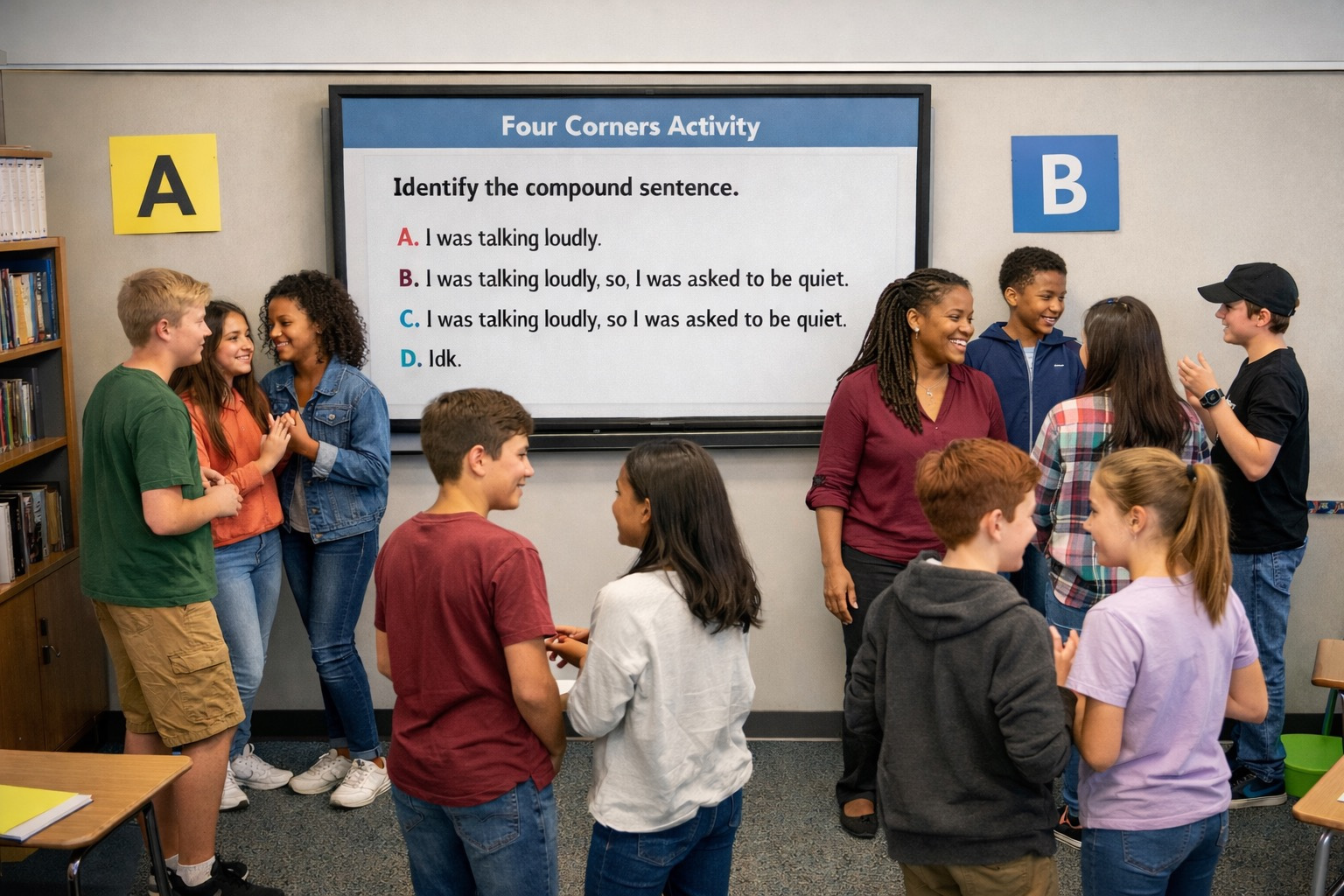
One example was the Four Corners activity.
For multiple-choice questions, each corner of the room represented a different answer. Students moved to the corner that matched their answer, discussed their reasoning with classmates, and sometimes changed their position after hearing other perspectives.
It turned assessment into movement, discussion, and deeper thinking.
This activity alone reduced disruption because students were engaged.
I used Four Corners often for warm-ups or practices with multiple choice questions.
Leadership Matters Too
Even the most thoughtful classroom ecology cannot work if teachers are not supported.
Teachers need leaders who:
- back them when expectations are enforced
- maintain consistent behaviour systems
- understand that environment affects behaviour
- support both permanent staff and substitute teachers
When teachers feel supported, they are more confident creating the environments students need.
When they feel unsupported, burnout accelerates. This is an essential part of the conversation, and one I will explore more meaningfully in another article.
Read More on This Topic
Here are some articles I have written in more depth about how environment, leadership, and classroom management affect both students and teachers:
- What happens when one student is disruptive
- The untold struggles of guest teachers
- Balancing discipline and compassion in schools
- My Sky Turns 16
- The value of education and behaviour issues in public schools
If you are a school leader thinking about behaviour, engagement, and teacher wellbeing, I encourage you to look not only at policies but also at the environments and systems that sit beneath behaviour.
Sometimes the most powerful intervention is a better-designed learning environment supported by effective leadership.
The Research Behind Classroom Ecology
Over the years, some people were skeptical of the way I designed my classrooms. Lamps instead of harsh fluorescent lighting. Plants around the room. Calm music during independent work. Flexible spaces where students could move rather than sit still for long periods. They were especially leery of my use of essential oils throughout the day.
However, what I was doing intuitively as a teacher is increasingly supported by research.
Studies in environmental psychology, education, and cognitive science show that the physical and sensory environment of a classroom significantly affects learning, engagement, and behaviour.
For example, research from the University of Salford found that classroom design can influence student learning progress by as much as 16% in a single academic year. Factors such as lighting, layout, flexibility of space, and student ownership of the environment all play a role in how effectively students learn.
Studies show that incorporating movement into lessons improves attention, memory, and executive functioning while reducing disruptive behaviour. Activities that allow students to stand, move, and interact with one another help maintain engagement and prevent boredom.
Music can reduce stress, improve focus, and support sustained attention during independent work. Music cues can also help regulate classroom transitions, providing predictable signals that help students move from one activity to another.
Harsh fluorescent lighting has been linked to increased fatigue and stress, while softer or more natural lighting conditions can improve both students' and teachers' mood and concentration.
Plants and natural materials can make a signficant difference. Studies on biophilic design show that exposure to natural elements in indoor spaces improves wellbeing, attention, and cognitive functioning.
While research on aromatherapy in classrooms is still emerging, studies in psychology and healthcare settings suggest that certain scents can influence mood and cognitive functioning. Lavender, for example, is associated with relaxation and reduced anxiety, while peppermint has been linked to increased alertness and cognitive performance.
The Classroom I Built Before Research Caught Up
In many ways, what I was doing instinctively in my classroom as a teacher without credit is now being supported by research: environment affects behaviour. At the time, I did not always receive credit for this work. In fact, some people mischaracterised what I was doing and believed I was creating harm when there was none.
Years later, some of the same school systems that misunderstood my methods began adopting similar approaches district-wide.
While there are times I have doubted myself because of how others framed me or my work, this is not one of them.
In this area, I am confident.
When classrooms are intentionally designed to support regulation, engagement, and comfort, students are more likely to participate, focus, and learn.
When behaviour improves, teachers can spend more time teaching rather than constantly managing disruption.
The classroom ecology I created grew out of years of observing students carefully and asking a simple question: What kind of environment helps students feel regulated, welcomed, and ready to learn?
I also asked another question that many teachers do not want to say out loud: What kind of environment do I want to be in all day, every day?
The answers to those questions shaped the classrooms I built.
And no one can take that away from me.
— Marsha Kerr Talley
Live Inspired | Turning Pain Into Possibility™
Sources
- Barrett, P., Davies, F., Zhang, Y., & Barrett, L. (2015). The impact of classroom design on pupils’ learning. Building and Environment, 89, 118–133. https://doi.org/10.1016/j.buildenv.2015.02.013
- Donnelly, J. E., Hillman, C. H., Castelli, D., et al. (2016). Physical Activity, Fitness, Cognitive Function, and Academic Achievement in Children: A Systematic Review. Medicine & Science in Sports & Exercise, 48(6), 1197–1222.
- Hallam, S. (2010). The Power of Music: Its Impact on the Intellectual, Social and Personal Development of Children and Young People. International Journal of Music Education.
- Guardino, C., & Fullerton, E. (2010). Changing Behaviors by Changing the Classroom Environment. Teaching Exceptional Children.
- Doxey, J., Waliczek, T., & Zajicek, J. (2009). The Impact of Interior Plants in University Classrooms on Student Course Performance and Perceptions of the Course and Instructor. HortScience.
- Hathaway, W. (1995). Effects of School Lighting on Physical Development and School Performance. Journal of Educational Research.
- Moss, M., Cook, J., Wesnes, K., & Duckett, P. (2008). Aromas of Rosemary and Lavender Essential Oils Differentially Affect Cognition and Mood. International Journal of Neuroscience.
- Kritsidima, M., Newton, T., & Asimakopoulou, K. (2010). The Effects of Lavender Scent on Dental Patient Anxiety Levels. Community Dentistry and Oral Epidemiology.
- OECD. (2020). Teacher Well-being and Retention Reports.
- SAMHSA. (2014). Trauma-Informed Care in Behavioral Health Services.
— Marsha Kerr Talley
Live Inspired | Turning Pain Into Possibility™
Subscribe to read more reflections like this.
You can also read the full archive on Substack .